Showing posts with label Education. Show all posts

Wednesday, June 20, 2012

Improving Elementary Education in India

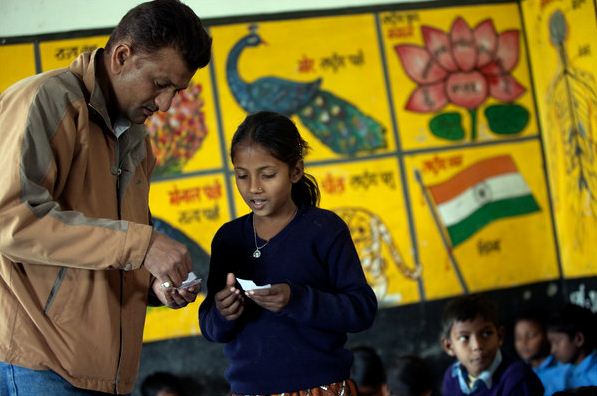
An arithmetic class at Government Primary School Kandoli Raipur in northern India. The school is part of an effort to improve elementary education underwritten by one of the country’s richest men, Azim H. Premji, chairman of the information technology giant Wipro.

Nine-year-old Arjun takes his turn keeping the shoes and slippers outside his classroom in order. His school, Government Primary School Nagla, is included in the Premji Foundation's efforts to overhaul the way students are taught and tested at government schools. 


Children at the Nagla school have fun acting out a poem. Students are encouraged to write stories and pursue independent projects, rather than perform rote exercises out of textbooks.  


Dhananjay, 10, sketches during a group story-telling session at the Nagla elementary school. Within India, there is widespread recognition that the country has not invested enough in education, especially at the primary and secondary levels.  


Ten-year-old Mehroon, during a math class at  Government Primary School Ramjeevanpur, a school participating in the Premji Foundation program. Only about one-third of fifth graders in India can perform simple division problems in arithmetic, and most students drop out before they reach the 10th grade.


In a math class at Government Primary School Ramjeevanpur, Jasmine, 10, offers an answer to her teacher. Education reformers in India point to success in China, where 94 percent of the population is literate, compared with 64 percent in their own country.  


Pankaj Malik teaches arithmetic using a  tool designed to develop reasoning through play. New efforts to train teachers and provide adequate equipment are under way. 


The curriculum at Government Primary School Ramjeevanpur is break from traditional public schools in India, where students have long been drilled on memorizing facts and regurgitating them in stressful year-end exams that many children fail.    


Time for home for these Ramjeevanpur schoolchildren. Mr. Premji said he hoped his foundation would eventually make a difference for tens of millions of students in India by focusing on critical educational areas like exams, curriculum and teacher training.  


Source: NYT

Skipping Rote Memorization in Indian Schools...!!!


PANTNAGAR, India — The Nagla elementary school in this north Indian town looks like many other rundown government schools. Sweater-clad children sit on burlap sheets laid in rows on cold concrete floors. Lunch is prepared out back on a fire of burning twigs and branches.
Dhananjay, 10, sketches during a group story-telling session at the Nagla elementary school. NYT
But the classrooms of Nagla are a laboratory for an educational approach unusual for an Indian public school. Rather than being drilled and tested on reproducing passages from textbooks, students write their own stories. And they pursue independent projects — as when fifth-grade students recently interviewed organizers of religious festivals and then made written and oral presentations.
That might seem commonplace in American or European schools. But such activities are revolutionary in India, where public school students have long been drilled on memorizing facts and regurgitating them in stressful year-end exams that many children fail.
Nagla and 1,500 other schools in this Indian state, Uttarakhand, are part of a five-year-old project to improve Indian primary education that is being paid for by one of the country’s richest men, Azim H. Premji, chairman of the information technology giant Wipro. Education experts at his Azim Premji Foundation are helping to train new teachers and guide current teachers in overhauling the way students are taught and tested at government schools.
For Mr. Premji, 65, there can be no higher priority if India is to fulfill its potential as an emerging economic giant. Because the Indian population is so youthful — nearly 500 million people, or 45 percent of the country’s total, are 19 or younger — improving the education system is one of the country’s most pressing challenges.
“The bright students rise to the top, which they do anywhere in any system,” Mr. Premji said over lunch at Wipro’s headquarters in Bangalore, 1,300 miles south of Uttarakhand. “The people who are underprivileged are not articulate, less self-confident, they slip further. They slip much further. You compound a problem of people who are handicapped socially.”
Outside of India, many may consider the country a wellspring of highly educated professionals, thanks to the many doctors and engineers who have moved to the West. And the legions of bright, English-speaking call-center employees may seem to represent, to many Western consumers, the cheerful voice of modern India.
But within India, there is widespread recognition that the country has not invested enough in education, especially at the primary and secondary levels.
In the last five years, government spending on education has risen sharply — to $83 billion last year, up from less than half that level before. Schools now offer free lunches, which has helped raise enrollments to more than 90 percent of children.
But most Indian schools still perform poorly. Barely half of fifth-grade students can read simple texts in their language of study, according to a survey of 13,000 rural schools by Pratham, a nonprofit education group. And only about one-third of fifth graders can perform simple division problems in arithmetic. Most students drop out before they reach the 10th grade.
Those statistics stand in stark contrast to China, where a government focus on education has achieved a literacy rate of 94 percent of the population, compared with 64 percent in India.
Mr. Premji said he hoped his foundation would eventually make a difference for tens of millions of children by focusing on critical educational areas like exams, curriculum and teacher training. He said he wanted to reach many more children than he could by opening private schools — the approach taken by many other wealthy Indians.
Mr. Premji, whose total wealth Forbes magazine has put at $18 billion, recently gave the Azim Premji foundation $2 billion worth of shares in his company. And he said that he expected to give more in the future.
Those newly donated shares are being used to start an education-focused university in Bangalore and to expand and spread programs like the one here in Uttarakhand and a handful of other places to reach 50 of India’s 626 school districts.
The effort’s size and scope is unprecedented for a private initiative in India, philanthropy experts say. Even though India’s recent rapid growth has helped dozens of tycoons acquire billions of dollars in wealth, few have pledged such a large sum to a social cause.
“This has never been attempted before, either by a foundation or a for-profit group,” said Jayant Sinha, who heads the Indian office of Omidyar Network, the philanthropic investment firm set up by the eBay founder Pierre Omidyar.
Although the results in Uttarakhand are promising, they also suggest that progress will be slow. Average test scores in one of the two districts where the foundation operates climbed to 54 percent in 2008, up from 37.4 percent two years earlier. (A passing mark is 33 percent or higher.) Still, only 20 of the 1,500 schools that the Azim Premji foundation works with in Uttarakhand have managed to reach a basic standard of learning as determined by competence tests, enrollment and attendance. Nagla is not one of the 20.
“We are working with the kids who were neglected before,” said D. N. Bhatt, a district education coordinator for the Uttarakhand state government. “You won’t see the impact right away.”
The Azim Premji Foundation helps schools in states where the government has invited its participation — a choice that some educational experts criticize because it seems to ignore fast-growing private schools that teach about a quarter of the country’s students, including many of India’s poor.
Narayana Murthy, a friend of Mr. Premji and chairman of Infosys, a company that competes with Wipro, said he admired the Premji Foundation’s work but worried it would be undermined by the way India administers its schools.
“While I salute Azim for what he is doing,” Mr. Murthy said, “in order to reap the dividends of that munificence and good work, we have to improve our governance.”
Mr. Premji says his foundation would be willing to work with private schools. But he argues that government schools need help more because they are often the last or only resort for India’s poorest and least educated families.
Mr. Premji, whose bright white hair distinguishes him in a crowd, comes from a relatively privileged background. He studied at a Jesuit school, St. Mary’s, in Mumbai and earned an electrical engineering degree at Stanford.
At 21, when his father died, Mr. Premji took over his family’s cooking oil business, then known as Western Indian Vegetable Product. He steered the company into information technology and Wipro — whose services include writing software and managing computer systems — now employs more than 100,000 people. He remains Wipro’s largest shareholder.
While the foundation has been welcomed by government officials in many places, the schools in Uttarakhand provide a glimpse of the challenges it faces.
After visitors left a classroom at Nagla school, an instructor began leading more than 50 fifth-grade students in a purely rote English lesson, instructing the students to repeat simple phrases: Good morning. Good afternoon. Good evening. Good night. The children loudly chanted them back in unison.
Another teacher later explained that the instructor was one of two “community teachers” — local women hired by a shopkeeper to help the understaffed school. Although under government rules Nagla should have nine trained teachers for its 340 students, it has only four.
Underfunding is pervasive in the district. But so are glimmers of the educational benefits that might come through efforts like the Premji Foundation’s.
Surjeet Chakrovarty, now a 15-year-old secondary school student, is a graduate of Nagla and still visits his old school regularly. The son of a widower who is a sweeper at a local university, Surjeet aspires to become a poet and songwriter — something he attributes to the encouragement of his former teachers at Nagla.
“My teachers here gave me so much motivation to write,” he said.
One of those Nagla teachers, Pradeep Pandey, shared credit with the Premji Foundation, and its assistance in developing new written and oral tests.
“Before, we had a clear idea of the answers and the child had to repeat exactly what we had in mind,” Mr. Pandey said. “We can’t keep doing what we did in the past, and pass them without letting them learn anything.”
Source: NYTimes

A Bid to Redefine Indian Education...!!!


By JAMES BROOKE

Facing final exam pressures common to all boarding schools, students here have found an uncommon way to unwind. Following the bouncing ponytail of Al Blackhorse, their history teacher, Indian students hop, skip and dip in a clockwise whirl of the Navajo grass dance.
It's spiritual, social and a stress reliever," Mr. Blackhorse said after the taped chants and drumbeats of the late afternoon powwow faded from the brand new campus of the Native American Preparatory School.
For decades, the words "Indian boarding school" could conjure up fearful, Dickensian images: cold showers barracks where white teachers cut Indian boys' braids, burned their traditional clothing, handed out English names and forbade them from speaking the language of their parents.
Richard Pratt, founder of the first Federal Indian boarding school, set the tone in 1892 when he lectured a congress of educators: "Kill the Indian in him and save the man."
One century later, on a 1,600-acre campus dotted with pinon pines and cut by the Pecos River, a group of white and Indian educators are starting what they hope will become a model for a different kind of Indian boarding school education for America's next century.
"We are saying, yes, we are native people, but we are also connected to the rest of the world," said John Anthony Reyna, a Taos Pueblo who teaches art here. Operating from modern adobe buildings originally built for a resort, the new school is believed to be the only privately financed boarding school for Indian students in the United States.

After seven years as a summer school, the Preparatory School moved in August into its new, $6 million campus here in high mountains 40 miles east of Santa Fe. In this setting, the school offers a rigorous, traditional curriculum coupled with studies of Indian literature, art and history, as well as weekly visits by Indian leaders, artists and professionals.
The idea is to offer bright Indian high school students the kind of elite education that privileged white children have long enjoyed at New England boarding schools. But instead of paying an annual tuition valued at $16,000, Indian families pay only $900.
"We want to fill the American Indians' educational hole -- doctors, scientists, educators, business leaders," said Richard Prentice Ettinger, the chairman of the school's board. The son of a founder of the Prentice Hall publishing house, Mr. Ettinger has made the family foundation, the Educational Foundation of America, the school's principal financial backer. With an annual budget of $1.7 million, the school is almost entirely privately financed.
The need for improved Indian education is clear. Scoring at the bottom of America's five major racial groups, only half of Indian students graduate from high school and only 3 percent graduate from college.
At the same time, Congress shows little interest in increasing Federal investment in Indian education. In its most recent version of the Federal budget, Congress calls for a 10 percent cut for the Bureau of Indian Affairs, an agency that maintains 187 schools.
Closer to home, Congress this year cut in half, to $5 million, the budget for Santa Fe's Institute of American Indian Arts, the nation's only arts college for Indians. With Congress debating an end to Federal financing altogether next year, the Institute's President, Perry Horse, resigned on Nov. 21.
Here, on rolling hills of the western Plains where Pecos Indians once hunted buffalo, the Native American Preparatory School may be forging a formula for improved educational results. A followup study of 50 students from the 1988 summer session found that five years later three-quarters were enrolled in college.
The school not only combats the low expectations that traditionally handicap teachers of Indians, but it also combats the low self-esteem that traditionally handicaps Indian students. In Mr. Reyna's art class, students work on baskets and masks under a wallboard that proclaims: "I am talented, skillful and intelligent! I look, act, think and dress like a winner!"
For some Indian teen-agers, accustomed to undemanding reservation schools, the educational atmosphere here is too hot.
In early September, only a few days after the first freshman class of 50 students arrived, a mini-riot erupted on campus, leaving a trail of broken lights and wounded feelings.
"Everything around here says you are in a resort, then you get nailed with homework," Norman E. Carey, the head of the school, said as he strolled the grounds on a recent afternoon. "Some of the students never had homework before. A great deal of anxiety contributed to the flare-up."
The school closed for 10 days as a result of the disturbance. When it reopened, two teachers and eight students did not return.
But, as the school nears the end of its first term, many of the 40 students expressed enthusiasm in interviews.
"Time goes by so fast here -- one day you think it's Thursday and it's already Saturday," said Nikki Nez, a 14-year-old who wore a Navajo-style choker, fashioned from bone, brass beads and artificial sinew.
"Back in Santa Fe, I felt like I wasn't working hard -- and I was getting A's and B's," she continued. "This is a big change, from easy to real hard."
The daughter of a woodworker who dropped out of high school, Nikki said she was "hoping to go to Stanford or Berkeley."
Teachers here say they work to draw Indian children out of their traditional classroom reticence that stems from the students either viewing the teacher as an elder, worthy of rapt attention or being intimidated by non-Indians in the class.
Fred Leon, a 14-year-old from Laguna Pueblo, discussed his new assertiveness in an interview a few minutes after he addressed the student body about his fall-term art projects.
"At home, I was mixed with Anglos and Mexicans -- the others dominated the class, and I felt left out," he recounted. "Here, it's Native Americans. You get attention, you get called on."
After three months, Fred, the son of a small rancher, said he was still in awe of the school's creature comforts. "There's only two to a room," he said, "and you get a big old bed all to yourself."
With plans to steadily expand until it has a traditional four-year student body, the school is starting a $20 million capital drive to raise money to build additional housing for faculty and students, a library, a gymnasium and a science laboratory.
Although only a tiny fraction of Indian students will ever have the opportunity to attend a school like this, school officials believe they can set a model for Indian education and provide role models for tribal populations. Already, this drop in the bucket is making some local splashes.
"At home on the reservation, there is only TV and drunks," said Denisa Livingston, a 14-year-old from Shiprock, Ariz. "When I go home now, people look at me as a model."
And for students who want to know how the old Indian boarding schools were, they need only to ask Mr. Blackhorse, a 33-year-old veteran of the war in the Persian Gulf.
"Everything was very regimented -- you marched around campus, there were bunk beds, open bay showers all together," the teacher recalled of his New Mexico boarding school of 25 years ago. "Everything stressed the assimilation process. I was always getting intimidated by the Anglo teachers. I didn't want to ask questions in class."
Here, school directors encourage close family ties. Students can go home every other weekend. Telephones in their rooms can receive incoming calls. Parents can work off their tuition bills by spending weekends as dorm monitors.
The other evening, after students had drifted out of the cafeteria after dinner, Mr. Blackhorse recalled how old-style Indian boarding schools used to handle the family unit.
"I remember my grandparents dropping me off at the school, when I was 4 years old," he recounted. "I remember seeing their old car going down the road and running for the door. The older boys stopped me."
Source: NYTimes

The Global Search for Education: More From India


Is there a future for a US - India partnership in education?

In his remarks at the recent Brookings Institute conference in Washington, Deputy Secretary of State William J. Burns commented, "We are counting on India's rise, not just as an economic partner, but as a global power -- one that engages everywhere from Latin America to the Middle East to South Asia."
Is there also a partnership opportunity in education? What might these two education systems be able to learn from each other?
In the US, we have a significant poverty problem that has a large impact on the educational readiness of children from poor and low income families. 1 in 5 children live in poverty and 1 in 4 rural children live in poverty. 38.5% of rural children are eligible for free or reduced price school meals. The average cognitive scores of preschool-aged children in the highest socioeconomic group are 60% above those of low-income children. (Information provided by Save the Children US Programs)
Dr. Madhav Chavan, CEO and Co-founder of the Pratham Organization notes:
"On the face of it, the two systems are at least a century apart and may have nothing to learn from each other. Indian educators would need to look at how the US schools evolved over the last two centuries, and the US counterparts may want to look at how similar the root causes of poor learning are in schools where children of the poor go. I have been thinking lately that the basic model of the school is fast becoming outdated in the modern times. The challenges India faces are also an opportunity to move away from the two centuries old model of schooling. US school systems have huge resources to try something new. Perhaps both sets of educators should sit down and ask what kind of schools are needed for this century and if they can be systematically developed over the next twenty years."
2011-10-02-cmrubinworldmorefromindia5300.jpgThis week in The Global Search for Education, Dr. Chavan discusses the major issues facing India's education system and some of the solutions Pratham (one of the largest non-government organizations working with under privileged children) is putting in place to deal with them. Pratham began by offering pre-school education to children in the slums of Mumbai. These programs were subsequently expanded to nearly every state in India. Pratham's programs are aimed at supplementing governmental efforts. In 2005, it established the Annual Status of Education Report (ASER) to quantify the problems of education in India. In January 2007, it launched the Read India campaign to help India's 6 to 14 year olds learn to read, write, and do basic arithmetic.
"Our first objective in many cases is teaching the child basic skills such as reading and writing."

What proportion of adult Indians is educated?
According to the 2011 census figures, I believe that 25% of adult Indians are illiterate. 50% are semi-educated. Of the remaining 25%, roughly 2 to 4% have received a top class 'elite' education, 10% have received a good education and are from the upper middle class, and the other 12% have received some college education and are from the middle class.
What are the issues India faces in their education system at each of the different levels of learning?
I think India faces two basic educational system problems at three different levels. The first issue is one of quantity. The second is one of quality. The three levels are the basic level, i.e. the primary education (up to age 14), the secondary education (ages 14 to 18), and then higher education such as college and university. In all three levels, both issues of quantity and quality are the concern.

In our annual status of education survey we have learned the following. At the primary level, we find by 5th grade, in large numbers of Indian states, less than 50% of children can read a Grade 2 level text. Only about 40% can solve Grade 5 math problems. And so, 50% of our children at the primary level are at a risk of not entering or not completing secondary education level. That's what we face at the primary level. I believe that a large number of primary school students come from illiterate or semi-literate families who should be able to get additional support, including tutoring, to enable them to handle secondary education.
At the next level, that is secondary education and vocational schooling, the Indian infrastructure and the availability of trained teachers is very poor. My feeling is that we need to think beyond our existing educational learning curriculum, which is very linear. We need to become more innovative so that we can expand and improve learning at the higher levels.
Quality of testing and assessment (certification) is also a big issue. It is hard to say what our examination system actually examines with credibility. For example, if you are a first class student in one corner of India as opposed to another corner in India, it can mean two different things. I believe a solution to this is a standardized test for all.
What things can organizations such as yours do to help students who are not achieving in the existing system?
"The challenges India faces are also an opportunity to move away from the two centuries old
model of schooling."

In India, our first objective in many cases is teaching the child basic skills such as reading and writing. Our annual education survey also checks children's competence in these basic skills and also their school attendance. We also interview parents. Right now our system just expects teachers to "complete the curriculum" regardless of whether children learn. So looking at the indicators and outcomes is the first step. Based on those results that I have explained above, our team can intervene to help with learning gaps that exist in certain school communities. When we have the schoolteacher and the volunteer (who come from the same community or village as the child) working in sync with the teacher, progress has been made.
I think there is a need to have a very strong bridge between home and school so that parents can be told how the child is doing, especially if the child is not doing well, and so that parents can also help the child in some way.
Our middle class families can make up the learning gaps in our schools with private tutoring. So many middle class Indian students are learning all day in school, coming home, having a quick snack, and then rushing off for several more hours of tutoring. This of course can make children overburdened and overstressed.
Have Indian children started participating in the PISA test?
Yes, India is participating in two states. So let's wait and see how we do.
"50% of our children at the primary level are at a risk of not

 entering or not completing secondary education level. 

What do you think are the most important next steps to making the progress in the Indian educational system you would like to see?
We have to set short, mid, and long term outcome goals. We need to do this at the policy level, and so that means moving away from the current input oriented system we have. If we do that, we are addressing half the problem.
Second, we have to address our teacher training process. Teacher training in India is a big problem. Training needs to be revolutionized. In some states, they have tried to address it, but it comes up again and again. Some teachers have the knowledge, but that does not mean they can get the results from their students. Teachers learning how to teach and improving their practices is extremely important.
If these two things are done, then the third thing that we can address is how and what we test. We also need to open up our procedures for testing students. Credible standardized tests will be important to raise and maintain quality standards.
There is also too much emphasis on textbooks. I think we need to focus beyond books. Health, sports, the arts and handicrafts can give children a wider experience of the world. Somehow childhood is missing in our education. I'd like to see children have the opportunity to explore more. It is interesting that India has so many artists and yet art is not a part of our school system. These are important things that we don't define as knowledge. Being able to read and write is a critical objective. But our definition of education and knowledge has to expand beyond what we are currently teaching in schools. 
Source: 

Why a Liberal Arts Education Matters...!!!


Well, what is it going to be: engineering, medicine or commerce?

Most 12th-grade students in India are faced with this question, as they struggle to fit themselves into one of a few narrowly defined boxes. Heaven forbid someone might enjoy reading both Newton’s laws and Plato’s dialogues! Plato is clearly a waste of time with no practical, remunerative value. Or is it?
I grew up in Kolkata, India, and came to the United States as a freshman to study physics at Harvey Mudd College in Claremont, Calif. Harvey Mudd is a unique liberal arts college which specializes in science and engineering, while also honing its graduates to be well read in the humanities and social sciences. While taking intensive physics and mathematics classes, I also studied history, economics, linguistics, philosophy and creative writing. I am now pursuing a Ph.D. in theoretical physics at Princeton University.
Based on my experiences, I wanted to advocate for the value and necessity of a broad, liberal education rich in both technical subjects and the humanities.
The pragmatic attitude taken by most Indian students and parents is certainly understandable in a country where millions of students regularly compete for scarce college placements and job opportunities. The entrance requirements at Indian universities have steadily risen, with certain premier colleges in New Delhi posting the mind-boggling admission cutoff of 99 percent last year.
In this high-stress setting, students want to study whatever will land them a job, creating a college experience much more akin to “technical training” rather than intellectual exploration. However, I believe it is precisely today’s environment with a rapidly expanding, educated working class in India that makes an interdisciplinary liberal arts education all the more necessary.
In a global world dominated by so-called knowledge workers, the ability to communicate effectively and work well on a team is imperative. But besides raw technical ability, how do you develop the myriad other skills needed to distinguish yourself and excel in your job? How can you learn to inspire people so they want to work towards the sales goals you’ve set?
As a start, try an oratory class and read speeches given by paradigm-changing leaders. To learn the brevity, precision and charisma needed to write a funding proposal for your dream project, try a creative writing class. To incorporate vastly different perspectives from your team members, try classes in psychology and philosophy. These may help you understand where they might be coming from.
And nothing could be more practical than the humanities.
As the story goes, when three blind men felt an elephant, one concluded it was flat like a wall, another thought it sharp like a spear and the last was sure an elephant was thin like a snake. All were correct in their own way, just incomplete.
The ability to synthesize different perspectives into the big picture is far more powerful than narrow expertise in any single field. The social sciences offer perspectives from vantage points separated by time, place and society. Drawing and painting offer perspectives on what perspective even means. Critical thinking is the logical result of being able to simultaneously synthesize multiple ideas in one’s mind.
Real-world problems rarely ever have textbook solutions. More than anything, the purpose of a college education is to learn how to think critically and what questions to ask. Liberal arts colleges aim to mold their students into well-rounded, well-informed global citizens with a wide skill set — whether it is through elective or voluntary courses that push specialized students to be broader, or general requirements that force every graduate to know at least something about certain subjects.
In the throes of our current economic crisis, all conventional strategies for success are moot. All the more reason for a liberal arts education that creates resilient people who can invent creative solutions and always have new ways by which to try things differently.
As Albert Einstein said, “Imagination is more important than knowledge. Knowledge is limited; imagination encircles the world.”
Source: NYTimes

Dreaming Risks of India's Education Remaining Just like...!!!


At one of the better colleges in India’s capital, there is just one large room for 140 faculty members to sit and have a cup of tea or grade papers. “If even half show up, there aren’t enough chairs,” said Ghazala Amin, a history professor there. “There is no other place to work. In this situation, how do you expect teachers to work?”


The lack of amenities for faculty members is not the only issue. After 30 years at Jesus and Mary College, which is one of dozens administered by the University of Delhi, Ms. Amin makes the equivalent of $22,000 a year — less than half of what some of her better students will make in their first jobs. New opportunities offer not just more money for graduates but also mobility and flexibility, which are virtually unheard of for faculty at most of India’s colleges and universities.
All this means that India is facing a severe shortage of faculty members. But it is not just low pay and lack of facilities that are being blamed. According to a government report published last year, a massive expansion in higher education combined with a poor supply of Ph.D.’s, delays in recruitment and the lack of incentives to attract and nurture talent has led to a situation in which 40 percent of existing faculty positions remain vacant. The report’s authors, mostly academics, found that if the shortfall is calculated using the class size recommended by the government, this figure jumps to 54 percent.
Experts say this is the clearest sign that India will fail to meet the goal set by the education minister, Kapil Sibal, who has pledged to more than double the size of the country’s higher education system by 2020. They say that while the ambition is laudable, the absence of a long-term strategy to develop faculty will ensure that India’s education dream remains just that.
“This is a factor that we didn’t really study very carefully,” said Chiranjib Sen, one of the authors of the report and a professor at Azim Premji University in Bangalore. “It’s obvious that the faculty quality and numbers is a very crucial element in the quality of education.”
Mr. Sen says it is “a criminal thing” to increase the number of colleges and universities but not the faculty to run them. “If you can’t even manage what you have, how are you going to manage even more?”
This is a problem that has touched even elite organizations, including the Indian Institutes of Technology. The government, which funds them, has decided to increase the number of campuses to 15 from 7. Meanwhile, it has had to significantly increase the number of students to meet quotas for certain disadvantaged groups that were announced in 2008. At I.I.T. Delhi, for instance, the size of the student body has jumped from 4,800 to almost 7,000, almost entirely because of this policy. Where there should be 700 faculty members, or one for every 10 students, there are only 450, said M. Balakrishnan, the deputy director in charge of faculty.
He says the problem is not one of insufficient resources. Instead, there is a “huge misunderstanding” about how quickly his organization can grow and attract faculty. “The research institution cannot grow very quickly,” he said. “It takes time. We need to provide housing and research facilities for them to want to be here.”
Whatever the reason, the fact that there is a faculty shortage “has an enormous impact on research,” said Krishna Jain, a retired physics professor from I.I.T. Delhi. “You spend so many hours teaching, so how can you do research?”
And, Mr. Jain said, it is now more difficult to attract good students to support faculty in research programs for one simple reason: “Salaries cannot compete with the business world. So everyone wants to do an M.B.A. There’s too much emphasis on what you earn.”
In India, it was the information technology industry that allowed millions of Indians to earn good salaries. But this skewed the expansion of engineering education, said Mr. Balakrishnan of I.I.T. Delhi, because small private colleges accounted for the bulk of growth. And because these were mainly money-making enterprises, a “large number” of the professors there were not, in his opinion, qualified to teach. “So the faculty shortage may be actually 80-85 percent.”
For him, addressing the faculty shortfall problem is one part of the larger question of who should lead the huge expansion of India’s higher education system. Mr. Balakrishnan said India could do this only if education was subsidized. To maintain quality, he said, a massive investment by the government was needed, as well as some support from those businesses that wanted to launch institutions in the “philanthropic mode.”
Dinesh Mohan, his colleague at I.I.T. Delhi, said only the government could ensure that everyone received a quality education. “There is no example from any country in the world where it has not come from government,” he said.
Citing the United States as an example, he said initiatives such as the G.I. Bill and public funding of even top private universities ensured that no academically excellent student was denied admission. “What you have is a churn — classes mingling,” he said. “Innovation comes out of this process. A large proportion of faculty in schools and universities comes from this. They’ve understood the importance of poor people entering the system for better academic output. Rich people’s children do not typically become professors.”
Closer to home, Mr. Mohan added, there was an even bigger success story in the making. “You can make the quantum leap,” he said, using a phrase used often by India’s education minister, “and China has shown that.”
He said that while India produced about 700 engineering Ph.D.’s last year, about 6,000 earned such degrees in China. Mr. Mohan said China’s large state-owned firms had been asked to hire more Ph.D.’s, and that the same needed to be done in India. This, he added, would see many more Indians enrolling in such programs, some of whom would enter academia.
Mr. Sen, the professor in Bangalore, said the Chinese had not only increased capacity but quality, too. “They have been doing all kinds of experiments to make sure that their academic institutions maintain standards, at least in the technical field,” he said. For example, some universities have two tracks in the same department. “If you publish or have a degree from abroad, you will be put into the top track. And if you don’t perform, you’ll be dumped.”
This is not yet happening in India, according to Mr. Jain. “At a place like Harvard, only one in five appointments gets tenure,” he said. “In India, once you make an appointment, after a year you’re assessed. There’s a probation period of one year, but that’s just an eyewash.”
This type of quality constraint, coupled with low salaries for academics and the overwhelming rise of private colleges whose fees keep most students out are not good signs, said Ms. Amin, the history professor. She, for one, did not believe that India was on target to increase its gross enrollment ratio — the proportion of eligible students actually enrolled in colleges and universities — to 30 percent, from 12.5 percent to 13 percent, by 2020.
“On the one hand, you want inclusive growth. But on the other, fees will go up” if the expansion of private education continues unabated. “With the kind of situation there is, I don’t see that quantum leap happening. I don’t see it happening in the next 25 years.”
And Kavita Sharma, the former principal of a college that is part of the University of Delhi, also did not expect to see higher education grow at the rate India’s leaders talk about. She said that while the contents of the report on faculty shortages were not new, the fact that the government had published it could help to change things. “Now that it’s out in the open, out-of-the-box solutions will also start coming. I do see that every day higher education is being written about, talked about, which didn’t happen some years ago.My own feeling is, as your universities improve, then the profession will be attractive.”
Mr. Balakrishnan of I.I.T. Delhi, meanwhile, was more optimistic. He felt India could enroll as much as 25 percent of eligible students in colleges and universities — about twice the current figure — by the end of this decade. “Tangible changes are happening,” he said. “The debate that has happened in the last few years has taken people out of their comfort zones. There is more consensus across the board that we need to scale quality education.”
Source: NYTimes

Monday, June 18, 2012

Educating India..???


Words of Pandit Jawaharlal Nehru in a message to Indians overseas, on 15th August 1947
"On this day of liberation the motherland sends her affectionate greetings to her children abroad. She calls them to her service and to the service of freedom wherever they might be. Every Indian abroad is a representative of India and must ever remember that he has the honour of his country in his keeping. That is a proud privilege and responsibility”.

These are some new slogans we have been hearing a lot lately. Now the point is, India is trying to educate its citizens and she has been trying for years! So how far has she succeeded?


First of all, the abysmal ground reality is that India’s literacy rate is still below 75 per cent. Though the rate has of course increased over the years, we are not yet there. And we still have a long way to go! The adult literacy rate (15 yrs and above) is about 61 per cent while the youth rate (15-24 yrs) is about 73 per cent. Amongst the states, Kerala has the highest literacy rate and Bihar has the lowest. Nonetheless, the growth in literacy rate has been incredible. Most people know that literate females are fewer than their male counter parts in our country. At this point, one must keep in mind that most of India is rural and a bit orthodox in their thinking.
Today, as most of you might have noticed, English is becoming increasingly popular. Ever noticed that little kid who comes to you at the traffic signal? Doesn’t he know a few words of English? So would you call him literate or illiterate? The National Literacy Mission defines literacy as ‘acquiring the skills of reading, writing and arithmetic and the ability to apply them to one’s day-to-day life’. That child may not have gone to a school; he may not even know that he was talking in English! Most of them today don’t know ‘Hindi’ numbers, but on the other hand English numbers are on their finger tips. It is the same with directions and simple words like ‘yes’, ‘no’ etc. How many times have you sat in a rickshaw and then suddenly realized that the driver knows English? Or don’t you absent mindedly give him directions in English? Or what about when you just know the address of somebody’s place, and your driver helps you point out the house? Ever thought about how he reads those house numbers? I wonder how many people have realized that the digits on a cell phone are in English and not in Hindi or any other regional language. But it is a common misconception that just because a person knows English, people think he’s educated! Most of them know English only because that is what they have grown up hearing. Come to think of it, the logic people use indirectly means even a 2-3 year old kid is educated! On the other hand, many people also think that just because a person doesn’t know English, he is uneducated. This is also not true. Many people in India are educated in their regional language and not in either Hindi or English.
Today, the government is trying to increase the literacy rate with the help of a whole lot of new programs. The ‘Sarva Siksha Abhiyan’ was started in 2001, and it aimed at ensuring that all kids between the ages of 6-14 years attended school and completed 8 years of education by 2010. This wasn’t the first program to be launched but earlier programs weren’t as successful. One of the most popular schemes adopted to attract children to schools is the ‘Mid-Day Meals Programme’ launched in 1995. The department of education has started Bal Bhavan centres all over the country to promote creative and sports skills in children between the ages of 6-14 years. They conduct programs in fine arts, aero-modelling, computer education, sports, martial arts, performing arts etc. Off late, new programs to promote the education of girls have been initiated. One such incentive is a fixed amount of money which is given to the family at the end of the school life of a girl child.
Today, private companies too are lending a helping hand to this noble cause, Like the ‘Teach India’ program launched by The Times of India, or the NGO ‘Literacy India’ which helps underprivileged children with their dreams and aspirations of good quality higher education or the National Literacy Mission which pays special attention to women’s education. Another foundation that helps educate the underprivileged is The Smile Foundation. Mission Education is a national level program started by the foundation which focuses on basic education for underprivileged children and youth. They are working with ‘partner organizations’ in various states across India. One can visit the following link for more information on the organization. http://www.smilefoundationindia.org/
Infect, recently even a telecom company has started an advertisement campaign with the same theme — how to educate more people with less resources. It is something to think about. The idea is that through the concept of distance learning we can teach those who do not have access to schools and colleges near them.
One of the major problems we face is lack of infrastructure. It is not easy to create schools for our large and ever growing population. Today ‘good’ schools mean expensive schools, mostly private which most lower middle class people cannot afford. That is the fact—every year education gets more and more expensive. It is a vicious cycle—the more the population, the more the unemployment, and the more the unemployment, the more illiteracy, and the more the illiteracy, the more the population will keep growing! We need to break this cycle somewhere. And like they say, nothing is impossible! If each one of us contributes in our own way, we can make a difference. The government had come out with a slogan, a few years back – Each One Teach One – if we follow that slogan, we could easily help the cause. You don’t need to go out on the streets to find someone to teach, just look in your own house—the maid’s daughter, or that little boy who comes to collect the garbage. They should be studying instead of working. But yes since for them earning is important for survival, we can make a difference by giving them lessons. We just need to wake up from our complacent lives and try to make a difference!

Priya Ganguli

Friday, June 15, 2012

Indian education system and corruption: UNESCO


India’s education system is mired in corruption and a high rate of teacher absenteeism in the country was a key factor for it according to the new global study. The UNESCO’s International Institute of Educational Planning study on corruption in education released recently says that 25% teacher absenteeism in India is among the highest in the world, second only after Uganda that has a higher rate. The global average of teacher absenteeism is about 20%.

 Teacher absenteeism does not just affect quality of education; it is also a huge drain on resources resulting in the wastage of 22.5% of education funds in India the study said. Politics in teacher appointments and transfers is a major reason for teacher absenteeism according to a professor at National University for Education Planning and Administration.
The study identifies the absence of well established criteria for teacher recruitment a uniform policy on promotion, remuneration and deployment as some of the main reasons identified for teacher absenteeism. However the report found married teachers to be more regular at job than unmarried teachers.


In Bihar two of every five teachers were reported absent the figure in UP was reported to be one-third of the total teachers. However in states like Gujarat and Kerala the figure was lower than 15% the report based on several small studies.
Teachers also believe highly in private tutoring a practice identified by UNESCO as unethical. It does not complement learning at school and leads to corruption the report said. The practice of ghost teachers and involvement of teachers in mismanagement of schools were other gray areas identified in the Indian education system.
Another indictment of the sorry state of Indian education was the view held by students that cheating in examinations is their traditional right. In India universities cheating is now well-established. The fees for manipulating entrance tests ranges between $ 80 to $ 20,000 for popular programmes such as computer science, medicine and engineering the report said...!!!

Noted scientist and educationist Prof Yash Pal has said that there is maximum corruption in the education sector of the country. He expressed concern over the state of education in the country too. He was speaking at a ceremony where he was conferred with Shri Hari Om Ahsram Prerit Dr Vikram Sarabhai Senior Scientist Award - 2010 at the Physical Research Laboratory in Ahmedabad recently.
"Large-scale corruption is prevalent in the education system. Coaching classes are hell, as they are killing the creativity of students," said Prof Pal.
While expressing his opinion on higher education, he said, " Due respect has not been given to the universities in the country. We should be creating good universities but have not done so. IITs should be given total autonomy and given university status and raised to the level of the Massachusetts Institute of Technology (MIT). I think regulatory agencies like UGC and AICTE should be abolished." 
Apart from this, the Buti Foundation Award in Plasma Science and Technology for the year 2011 was also conferred on Banibrata Mukhopadhyay of the department of physics, at Indian Institute of Science, Bangalore.
Prof UR Rao, veteran scientist and chairman of council of management, PRL, was the chief guest at the function.
In his address Rao expressed, "We are still working with the space technology, which we have already developed. Now we should explore and develop new technologies. There is need for more research in space as we have barely been able to explore five percent of the universe, we still don't know where the energy of the universe originates from," he said.

Thursday, June 14, 2012

How to teach our Teachers..???


An integrated course after Class 12 makes sense.
The country needs to appoint 2.5 million teachers to comply with the Right to Education Act.
On every Children's Day, a lot is said on children's right to have a joyful, creative education, and the need for a better future for under-served children, including girl children, among other things.
From November 15, it is “business as usual”. In a Government school a bright young child would be asked to read a particular lesson loudly, after which the whole class would repeat. Not many children would understand the content of the lesson – even less number of children would think about what it means. Caning of children by unscrupulous teachers would continue.
Individual learning needs of the children would not be identified and the gap in statistics between the forward class and backward class, or between the girls and the boys would continue to be twenty percentage points.
It is not that issues and solutions are unknown. Vital issues – such as radically reforming pre-service teacher education, revamping underperforming institutions such as the District Institute of Education Training, developing top class teacher educators, ensuring much higher and meaningful participation of parents in their children's education – are discussed from time to time. However, the biggest bottleneck is translating these concepts into practice.

TEACHER EDUCATION

Let us take the example of Teacher Education. Everyone accepts that “teacher” is the most critical component in making quality education happen. The way teacher education is currently positioned is untenable and does not result in top quality professional teachers. In order that to happen, we need to completely professionalise pre-service teacher education.
A study of some of the developed nations – including the Scandinavian countries -- reveals that they have immensely benefited by making it compulsory for every teacher to have a Master's degree in teaching.
It addresses three critical aspects of a teacher – content knowledge (subject matter), pedagogy and a social perspective of the process of education. Thus, a proposal of a five-year integrated course after 12{+t}{+h} standard for every teacher makes enormous sense. In our complex socio-economic situation, we need teachers who are experimenters, scientists and researchers, besides being top-notch content experts.
There is a fair amount of agreement on the fact that the teacher eligibility test (TET) suggested under the Right to Education Act is an excellent way to ensure that everyone entering the teaching profession is of a certain quality – this of course, is provided the TET is of a fairly high standard.
During the next five years, the country needs to appoint and certify almost 2.5 million teachers to comply with the RTE Act. This is an unprecedented opportunity to ensure that high quality teachers enter the teacher stream.
Everyone involved is convinced that these ideas, if implemented right, have a high potential to change the quality of education in India.

RESISTANCE TO CHANGE

However, after arriving at this understanding, most discussions turn to ensuring that we don't ruffle too many feathers.
The strategies that emerge seriously compromise the original ideas. Under the garb of democratic and participatory methods, we dilute the actions so much that they are likely to lead to only incremental changes without addressing fundamental issues.
Even those who are convinced of the merit of bringing about changes in teacher education propose to retain the training period at four years (same as current), rather than agree to an integrated five year professional programme, since they “don't want to rock the boat”. Bureaucrats want to see concrete changes in their brief tenure of one year or so, and therefore reject any long term solutions. The administration prefers short-term programmes over fundamental changes to “show” some kind of change, rather than actually creating one. Nobody wants to bell the cat in convincing the teacher unions of the merits of the change required. In my opinion, the teacher unions would be quite reasonable in seeing the benefit to future generations.
We need to surely involve the stakeholders in deciding the best recourse in implementing policy decisions. But we cannot waste inordinate time in democratizing the process beyond a point.
The author is CEO, Azim Premji Foundation